







What is a three-step challenge and why this format exists
If the one-step challenge concentrates the entire evaluation into a single stage and the two-step challenge divides it into evaluation and verification, the three-step model takes the logic one step further: three stages with reduced profit targets in each. The premise is straightforward — demonstrate consistency over a longer period with more achievable goals per phase.
This format isn't the most widespread on the market. Currently around 12 prop firms offer three-step challenges, compared to over 30 offering one or two-step models. However, its recent growth responds to real demand: traders who prefer lower targets and a more gradual evaluation process.
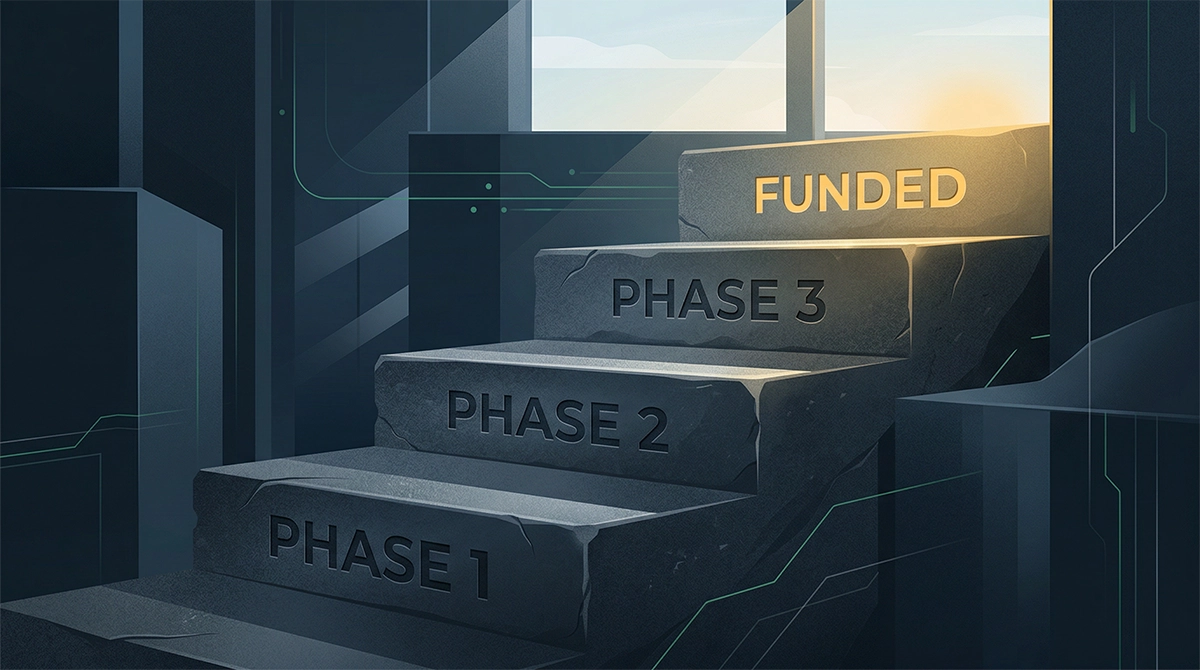
A three-step challenge divides the evaluation into three consecutive stages. In each one, you must reach a specific profit target — generally lower than in one or two-step models — without violating the risk rules. Only after clearing all three stages do you receive access to a funded account.
Who does it suit? Traders with conservative strategies that produce stable but moderate returns. If your system consistently generates 2-3% per month, a 6% target per phase is far more achievable than 10% all at once.
How it works, step by step
The process is a natural extension of the two-step model, with an additional verification stage:
1. Choose your account and pay the fee
Select your account size — from $2K at firms like Maven to $400K at FXify — and pay the evaluation fee. Prices tend to be competitive: by adding a third phase, many firms reduce targets and adjust their fees to keep the model attractive.
2. Phase 1: Initial evaluation
You receive a demo account with real market conditions. Your goal is to reach the first phase's profit target — which varies considerably between firms, from 2% at Fintokei to 8% at Alpha Capital Group. Daily and maximum drawdown rules are active from day one.
3. Phase 2: Intermediate verification
After passing phase 1, you automatically move to the second. The profit target may stay the same or decrease depending on the firm. Risk rules remain identical. This phase confirms that your phase 1 result wasn't a one-off.
4. Phase 3: Final verification
The third phase serves as definitive confirmation. The profit target is usually equal to or lower than phase 2's. Once cleared, you've demonstrated consistency across three distinct periods — a more rigorous filter than two phases, but with more accessible individual targets.
5. Funded account
After completing all three phases, you receive your funded account. You trade with the firm's capital and share profits according to the agreed profit split, which starts between 80% and 90% at most firms.
The key rules of the three-step model
The same four parameters that determine success or failure in any challenge apply here, but with nuances specific to this format:
Profit targets: lower, more distributed
This is the defining advantage of the three-step model. Individual targets are significantly lower than in other formats. Three main patterns exist:
Uniform targets — The same percentage in each phase. BlueGuardian, GoatFundedTrader, AquaFunded, and QT Funded use 6% across all three phases. Maven takes this to the extreme with just 3% per phase.
Decreasing targets — They drop progressively. ThinkCapital with its Nexus program asks for 7% / 6% / 5%, and KleinFunding starts at 6% and drops to 3% / 3%. The logic is that the first phase filters while the following ones confirm.
Progressive targets — They increase with each phase. Fintokei with StartTrader asks for 2% / 3% / 6%. An unconventional approach where difficulty rises as you advance, but the entry is extremely gentle.
| Firm | Phase 1 | Phase 2 | Phase 3 | Cumulative total |
|---|---|---|---|---|
| Maven | 3% | 3% | 3% | 9% |
| Fintokei | 2% | 3% | 6% | 11% |
| FXIFY | 5% | 5% | 5% | 15% |
| ThinkCapital | 7% | 6% | 5% | 18% |
| BlueGuardian | 6% | 6% | 6% | 18% |
| Alpha Capital | 8% | 4% | 4% | 16% |
Compared to a typical two-step challenge (8% + 5% = 13%) or one-step (10%), the cumulative total may be higher in three steps, but each individual stage is more manageable.
Drawdown: static and tighter than average
All three-step firms use static drawdown. Ranges go from Maven's 3% (the tightest in the entire industry) to QT Funded's 10%. Most sit at 6-8%. A 3% drawdown on a $50K account means just $1,500 of margin — this demands flawless risk management.
Daily drawdown ranges from 2% (Maven) to 5% (FXify, The5ers), with most firms at 4%. Calculation methods vary: some measure from the day's highest equity, others from the balance at the start of the session.
Time limits and minimum days
Most firms offer unlimited time per phase (Fintokei is the exception with 180 days). Minimum trading days range from 3 to 5 per phase. KleinFunding is unique with 0 minimum days. Some firms like BlueGuardian and GoatFundedTrader also require 3 profitable days with at least 0.5% profit.
Advantages of the three-step challenge
More accessible targets. A 6% per phase is easier to reach than 10% all at once. With targets like Maven's (3%) or Fintokei's (2% in phase 1), even ultra-conservative strategies can complete the evaluation without forcing trades.
Competitive pricing. The5ers charges just $22 for their $20K Bootcamp. Maven offers accounts from $13 for $2K. Among the lowest prices on the market.
Less pressure per phase. A bad day doesn't carry the same weight as in a one-step challenge. You have room to correct mistakes without the urgency of a single high target.
Natural consistency filter. Three phases is a more robust consistency filter than two. You don't need artificial consistency rules — the format itself acts as a filter.

Disadvantages and risks of the three-step model
Longer process. Where a two-step challenge takes 3-8 weeks, a three-step can easily extend to 2-3 months. That's more time without generating real income.
Triple opportunity for failure. A bad day in phase 3 erases weeks of work from phases 1 and 2. The accumulated fatigue of maintaining discipline across three evaluations is real.
Tighter drawdowns. Many firms compensate for lower targets with equally low drawdowns. Maven with 3% or FXify with 5% are stricter than the 10-12% typical in two-step challenges.
Fewer options. Around 12 firms offer this format versus over 30 with one or two-step models. Check all firms with three-step challenges in our curated listing.
Accumulated psychological fatigue. Phase transitions generate emotional peaks that, multiplied by three, amplify mental wear.
What top firms offer in three-step challenges
The range of options in three-step challenges is surprisingly varied. Here are the standout offerings:
Maven is the most conservative in the group: 3% / 3% / 3% targets with a maximum drawdown of just 3%. Prices from $13 for $2K. Ideal for manual traders with low-risk strategies, though EAs aren't allowed and there's a $10,000 monthly withdrawal limit.
The5ers Bootcamp offers the cheapest entry: $22 for a $20K account with 6% / 6% / 6% targets. The profit split starts at 50% but grows to 100% through scaling. It requires mandatory stop loss (maximum 2% per position) and doesn't allow hedging.
QT Funded has the most generous drawdown: 10% static with 6% / 6% / 6% targets. It's the option with the most room for error, though it requires mandatory stop loss on the funded account and has a 35% consistency rule.
AquaFunded stands out with a base profit split of 90% — the highest in the group, expandable to 100%. It includes the Wave Stop system that closes trades at -2% floating loss.
Fintokei StartTrader inverts the formula with 2% / 3% / 6% targets — difficulty increases with each phase. It's the only firm with progressive targets. The fee is fully refunded after the first payout.
KleinFunding is the only crypto-exclusive option (Bybit). With 0 minimum trading days, you can clear each phase in a single day. Drawdown is customizable between 6% and 14%.
Comparative table
| Firm | Plan | Targets | Daily DD | Max DD | Profit Split | From |
|---|---|---|---|---|---|---|
| Maven | 3 Step | 3/3/3 | 2% | 3% | 80% | $13 |
| The5ers | Bootcamp | 6/6/6 | 5% | 5% | 50-100% | $22 |
| Fintokei | StartTrader | 2/3/6 | 3% | 6% | 50-100% | $119 |
| Alpha Capital | Alpha Three | 8/4/4 | 4% | 6% | 80% | $67 |
| KleinFunding | Three Step | 6/3/3 | 3% | 6% | 40-100% | $31 |
| FXify | Three Phase | 5/5/5 | 5% | 5% | 80% | $39 |
| BlueGuardian | 3 Step | 6/6/6 | 4% | 8% | 85% | $30 |
| ThinkCapital | Nexus | 7/6/5 | 4% | 8% | 80% | $39 |
| GoatFundedTrader | 3 Step | 6/6/6 | 4% | 8% | 80% | $65 |
| AquaFunded | 3 Step | 6/6/6 | 4% | 8% | 90% | $77 |
| QT Funded | Prime 3 Step | 6/6/6 | 4% | 10% | 80% | $54 |
Strategies for passing a three-step challenge
Treat each phase as an independent challenge
The most common mistake is viewing all 3 phases as one long process. Each phase has its own target and its own rules. Plan each one separately: adjust your position size to that phase's specific target and don't carry over the mindset from a previous phase.
Leverage the low targets to be conservative
If the target is 6%, you don't need to risk 2% per trade. With 0.5% risk per trade and a 1:2 risk-reward ratio, you only need 6 winning trades to complete the phase. This allows you to be selective and patient.
Manage phase transitions
The transition between phases is the most psychologically dangerous moment. After passing phase 1, take a rest day before starting phase 2. After phase 2, do the same. Entering a new phase with the euphoria or exhaustion from the previous one is a recipe for failure.
Prioritize capital preservation
In a three-step format, losing the challenge in phase 3 is devastating because you've invested weeks in the first two. Adopt a preservation mindset: your goal isn't to maximize profits, it's to reach the target without approaching the drawdown. If you reach 4% profit with a 6% target, don't increase risk — stick to your plan.
Control daily drawdown with absolute discipline
With daily drawdowns of 2-4% at most three-step firms, your margin for error each day is minimal. Set your own limit at 1-1.5% daily. When you hit it, close the platform. The market opens tomorrow and your account is still alive.
Three-step vs two-step vs one-step: which to choose
The choice depends on your profile and strategy:
Choose three-step if:
- Your strategy produces moderate but consistent returns (1-3% monthly)
- You prefer low targets per stage even if the process takes longer
- You have the patience and discipline to maintain the same mindset for weeks
- You want a gradual evaluation process without high-target pressure
- You're looking for low entry prices (The5ers Bootcamp from $22, Maven from $13)
Choose two-step if:
- You want a balance between accessible targets and reasonable duration
- Your strategy can generate 8% in a few weeks without forcing
- You value having more firm options to compare
- You don't want a process extending beyond 2 months
Choose one-step if:
- Your strategy generates high returns in short timeframes
- You prefer to concentrate risk in a single period
- You want quick access to funded capital
- You don't need verification phases to demonstrate consistency
Check our complete guides on one-step challenges and two-step challenges for detailed comparisons of those models.
Mistakes that destroy a three-step challenge
Underestimating process fatigue. Without a plan to maintain mental energy — rest days, clear routines, daily limits — phase 3 will find you exhausted and prone to errors.
Changing strategy between phases. If your system worked in phase 1, keep it in phases 2 and 3. Adjust position size if necessary, not the system.
Ignoring tight drawdowns. A 3% drawdown (Maven) or 5% (FXify, The5ers) doesn't forgive mistakes. Calculate your maximum risk per trade before starting and respect it without exceptions.
Not reading each firm's specific rules. The5ers requires mandatory stop loss. KleinFunding allows passing each phase in a single day. Maven prohibits EAs. QT Funded has a 35% consistency rule. Read the full rules before paying.
Increasing risk at the end of a phase. If you're at 4% with a 6% target, the temptation to "close quickly" by increasing risk is dangerous. A losing trade can send you to the drawdown limit.
The place of three-step challenges in today's market
Three-step challenges occupy a specific niche in the prop firm industry: the segment of traders who prioritize accessibility over speed. With lower individual targets, competitive entry prices, and an evaluation process that rewards consistency over explosive performance, this format has established itself as a legitimate alternative to traditional models.
The current trend shows firms experimenting with varied target structures — uniform, decreasing, progressive — seeking to differentiate themselves in a market where competition for attracting traders grows increasingly fierce.
If you're considering a three-step challenge, start by reviewing the firms offering this format, compare conditions in our forex firms comparator, and choose the firm whose rules align with your strategy and risk tolerance.
Published on
The community
Join us on our mission to become the most influential family in funded trading.
Join the DiscordDon't miss anything
Promotions, news and funded trading analysis straight to your inbox.
No spam. Unsubscribe anytime.