How a Two-Phase Challenge Works: Complete Guide
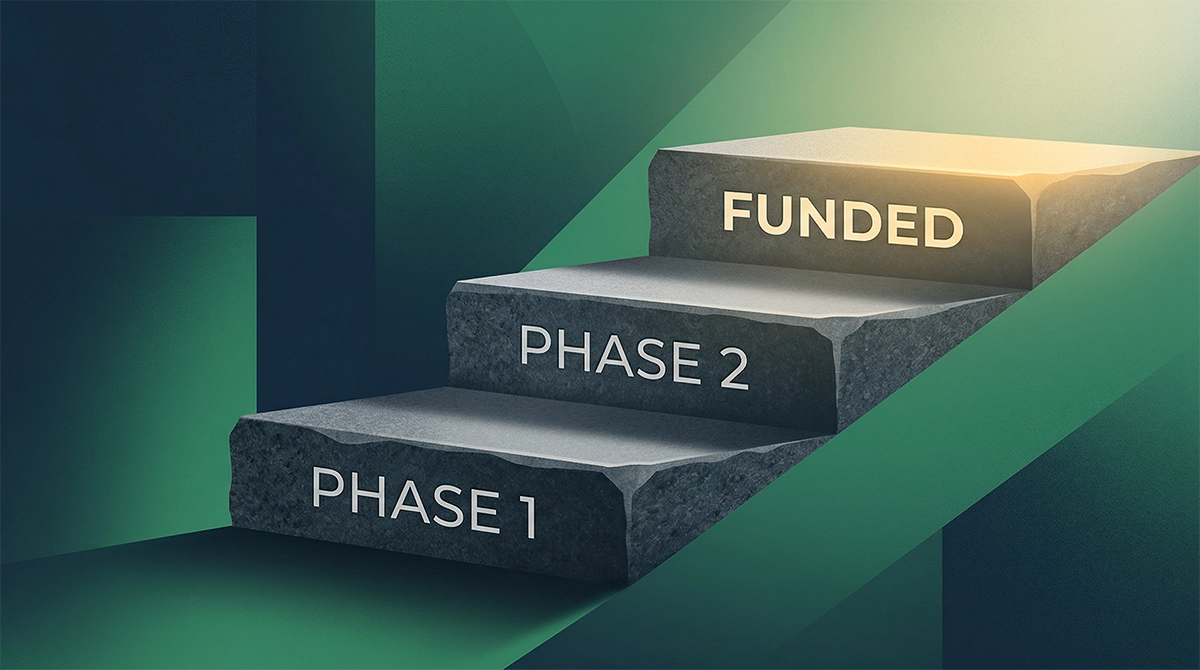
What is a two-step challenge and why it remains the most popular format
The two-step challenge is the original evaluation model in the prop firm industry. Despite the growing popularity of single-phase challenges in recent years, the two-step format remains the most widely offered — and most frequently chosen — by traders worldwide.
The reason? A balance between rigor and accessibility. The first phase tests your ability to generate profits. The second confirms it wasn't luck. This double filter benefits both the firm (which needs consistent traders) and the trader (who faces lower profit targets in each individual phase).
A two-step challenge divides the evaluation into two stages: an evaluation phase where you must reach a specific profit target, and a verification phase with a lower target that confirms your consistency. Only after passing both do you receive a funded account.
Compared to the one-step model — where everything rides on a single evaluation with a higher target — the two-step model distributes the pressure and reduces the profit target at each individual stage.
How it works, step by step
The process follows a fairly uniform pattern across most prop firms, though specific numbers vary between firms:
1. Choose your account and pay the fee
Select the account size you want to trade (ranging from $5K to $400K depending on the firm) and pay the evaluation fee. The most popular sizes tend to be $25K, $50K, and $100K.
2. Phase 1: Evaluation
You receive access to a demo account with real market conditions. Your goal is to reach the first phase's profit target — typically 8% to 10% — without violating any risk rules. Most firms require a minimum number of trading days (between 3 and 5 days) to ensure results aren't from a single aggressive trade.
3. Phase 2: Verification
If you pass the first phase, you automatically move to the second. Here the profit target drops considerably — generally to 4% or 5% — but the drawdown rules remain identical. This phase confirms that your profitability is sustainable and not the result of chance.
4. Funded account
After passing both phases, you receive your funded account. You trade with the firm's capital and share profits according to the agreed profit split, which typically starts between 80% and 90% in the trader's favor.
The key rules you need to master
Before paying for a two-step challenge, you need to thoroughly understand the four parameters that determine whether you pass or fail:
Profit target per phase
The first phase usually requires between 8% and 10% profit. The second phase lowers that target to 4%-5%. This staggered distribution is precisely what makes the two-step model more accessible than the one-step model for many traders.
For example, FTMO maintains its classic structure with profit targets complemented by a minimum of 4 trading days per phase. FundedNext, with its Stellar 2-Step program, requires a minimum of 5 trading days in each evaluation phase, while Funding Pips requires only 3 days.
Maximum drawdown (total loss)
This is the cumulative loss limit from your initial balance or highest equity point. There are two main types:
Static drawdown: calculated from your initial balance and doesn't change. If you start with $100K and the maximum drawdown is 8%, your account closes if it falls below $92K, regardless of how much you've earned before. Most two-step firms like FTMO, FundedNext, Blueberry Funded, and Bright Funded use static drawdown.
Trailing (dynamic) drawdown: moves with your highest balance. If you gain $5K, your limit goes up by $5K. This means profits don't give you extra cushion — a detail many traders overlook. Firms like FXify offer trailing drawdown variants in some of their two-step programs.
Daily drawdown
The maximum loss allowed in a single trading day. It resets each session and typically ranges from 3% to 5%. There are two ways it's calculated:
- Equity-based: measured from the day's highest equity point (stricter).
- Balance-based: measured from the balance at the start of the day (more predictable).
FTMO uses equity-based daily drawdown, while FundedNext calculates it on balance. Think Capital offers both modes depending on the chosen program (Intraday vs. Swing). This difference seems minor but can cost you the challenge if you don't understand it.
Time limits and minimum days
Most firms with two-step challenges offer unlimited time to complete each phase, removing the pressure to trade forcefully. However, nearly all require a minimum number of trading days:
- 3-day minimum: Funding Pips, FinTokei, Funded Elite
- 4-day minimum: FTMO
- 5-day minimum: FundedNext, Bright Funded, The5ers
This requirement exists to prevent traders from passing the evaluation with a single high-risk trade.
Advantages of the two-step challenge
Lower profit targets per phase
An 8% + 5% split is objectively more manageable than a 10-12% target all at once. For traders with conservative risk management — risking 0.5% or 1% per trade — reaching 8% is a matter of 8-16 good trades, not a perfect streak.
More room to adjust your approach
If you scrape through the first phase, you have the second to refine your strategy. Maybe you were too aggressive in phase 1 and need to reduce risk, or you discovered that a certain currency pair isn't behaving as expected. Phase 2 gives you that opportunity to correct course.
More accessible entry in some cases
Several firms offer slightly lower prices for their two-step challenges compared to one-step alternatives. The difference isn't always significant, but it exists.
More options in the market
As the most widespread model, you have more firms to choose from, more comparisons available, and more experiences from other traders as reference. You can check all firms offering two-step challenges in our curated listing.
Disadvantages and risks of the two-step model
The process takes longer
Where a one-step challenge can be completed in a week, a two-step challenge requires at minimum two weeks (adding up minimum days for each phase) and, realistically, between 3 and 8 weeks for most traders. That's more time paying spreads on demo without generating real income.
Psychological fatigue
Passing phase 1 generates relief that can become a trap. Many traders relax their discipline in phase 2 thinking "the hard part is over," when in reality phase 2 demands the same concentration with less emotional margin because you've already invested time and effort.
Double opportunity for failure
Each phase is an opportunity to violate the rules and lose the challenge. A bad day in phase 2 erases all phase 1 progress. This doesn't happen in a one-step challenge, where risk is concentrated in a single period.
What top firms offer in two-step challenges
The benchmark: FTMO
FTMO practically defined the two-step model. It offers static drawdown with a generous maximum, equity-based daily drawdown, and a minimum of 4 days per phase. The profit split starts at 80% and rises to 90% after the first scaling. One of its most relevant advantages: the challenge fee is refunded after the first profit payout on the two-step program.
Competitive alternatives
FundedNext with their Stellar 2-Step offers static drawdown, balance-based daily drawdown (more predictable than FTMO's), and an 80% profit split scalable up to 95% with add-ons. First payout arrives at 21 days, then every 14 days. They include a 25% capital scaling program.
Funding Pips stands out for its flexible profit split: you can choose between on-demand payment at 90%, weekly payments at 80%, or monthly payment at 100%. With static drawdown and only 3 minimum days, it's one of the most accessible options on the market.
GOAT Funded Trader offers two-step challenges with static drawdown and a 4-level scaling program that can take your profit split from 80% to 95%, plus a monthly salary starting from level 3. They provide 100:1 leverage during evaluation and 50:1 once funded.
For those seeking customization
Funded Elite lets you choose your profit split at checkout (60%, 70%, 80%, or 95%), along with payout frequency (every 3, 7, 14, or 21 days). They also include a free "Second Chance" if you fail: you retry with reduced drawdown and 50% profit split.
FXify offers two variants of their two-step program: "Classic" with static drawdown and "Standard" with trailing drawdown. This lets traders choose based on their risk tolerance. The profit split is 80%, expandable to 90% with a 25% add-on.
The most demanding with consistency rules
Some firms add additional rules that limit how much your best day can represent of total profits:
- FTMO (Phase 1 only): your best day cannot exceed 50% of total profit
- Top One Trader: 50% maximum per day in phases 1 and 2, and 30% once funded
- Funded Trading Plus: 35% during the challenge, 50% once funded
These consistency rules require you to demonstrate that your profitability doesn't depend on a single standout trade.
Phase 1 vs Phase 2: the differences that matter
While both phases share the same drawdown rules, there are key differences:
| Aspect | Phase 1 | Phase 2 |
|---|---|---|
| Profit target | 8-10% | 4-5% |
| Objective | Demonstrate profitability | Confirm consistency |
| Psychological pressure | High (everything starts here) | High (losing erases progress) |
| Minimum days | 3-5 depending on firm | 3-5 depending on firm |
| Drawdown | Identical | Identical |
Phase 2 isn't "easier" just because the target is lower. It's different. The pressure of not losing what you already earned in phase 1 creates a type of stress distinct from starting from zero.
Strategies for passing a two-step challenge
Plan each phase separately
Don't treat both phases as a single challenge. Design a specific plan for each. In phase 1, you might be slightly more aggressive since the target is higher. In phase 2, with a 4-5% target, you can reduce your risk per trade and prioritize capital preservation.
Manage daily drawdown with iron discipline
Daily drawdown remains the leading cause of challenge failures. If your limit is 4%, set your own mental limit at 2-2.5%. When you hit it, stop trading. The market opens tomorrow. Define your maximum risk per trade and respect it without exceptions.
Don't change your strategy between phases
If your system worked in phase 1, it works in phase 2. One of the most destructive mistakes is reaching phase 2 and deciding you need "something different" because the target is lower. Keep your approach, adjust only position sizing if necessary.
Use minimum days to your advantage
If the firm requires 5 minimum days and you hit the target in 3 days, the remaining two days are an opportunity to trade with minimal risk and add a small buffer. You don't need to force trades — simply execute your plan normally.
Mind the transition between phases
The moment between passing phase 1 and starting phase 2 is psychologically dangerous. Many traders feel euphoria after clearing the first phase and enter the second with overconfidence. Take a day to mentally reset. Emotions are not allies in an evaluation process.
Two-step vs one-step: which suits you
The choice depends entirely on your profile as a trader:
Choose two-step if:
- You prefer lower profit targets at each stage
- You value having a "test" phase before confirmation
- Your strategy is more conservative and needs time
- You want a broader range of firms to compare
- You're getting started with funded accounts
Choose one-step if:
- You have proven experience and don't need a second verification
- Your strategy generates high returns in short timeframes
- You'd rather avoid the fatigue of two evaluations
- You want faster access to funded capital
For a detailed comparison of the one-step model, check our complete guide to one-step challenges.
Mistakes that destroy a two-step challenge
Relaxing in phase 2. The lower profit target creates a false sense of security. A 5% target still requires discipline and a clear plan. It's not a formality.
Overtrading to compensate for losses. Losing one trade and opening three more to recover violates the daily drawdown faster than you think. If you lose, stop. Come back tomorrow.
Ignoring drawdown type. A static drawdown is not the same as a trailing one. If your firm uses trailing drawdown and you gain 5%, your new limit has moved up — and losing that 5% brings you closer to account closure even without having lost any of the original capital.
Not checking consistency rules. If your firm has a 50% consistency rule and you make 7% in a single day during phase 1, that day represents more than half of an 8% target. You could hit the profit target and still violate the consistency rule. Read the rules before you start.
Trading during news without checking restrictions. Some firms prohibit or penalize trading during high-impact events. The5ers, for example, allows news trading but with a 2-minute buffer and potential profit deduction. Verify each firm's rules.
The current landscape of two-step challenges
The two-step model remains the most widely offered format in the industry. Competition between firms has produced increasingly favorable conditions: higher profit splits, more flexible payout frequencies, add-ons to customize the experience, and scaling programs that let you grow capital up to $2M or more.
The current trend shows firms adding customization options — choosing your profit split, payout frequency, drawdown type — transforming the two-step challenge from a rigid format into one adaptable to each trading style.
You can compare conditions across all firms using our forex firms comparator, explore futures firms if that's your market, or browse firms with two-step challenges directly.
The community
Join us on our mission to become the most influential family in funded trading.
Join the DiscordDon't miss anything
Promotions, news and funded trading analysis straight to your inbox.
Don't miss anything
Promotions, news and funded trading analysis straight to your inbox.
Don't miss anything
Promotions, news and funded trading analysis straight to your inbox.
 Prop Firms
Refundable Prop Firm Fees: How They Really Work
What a refundable fee really means, when it is returned, and what conditions different prop firms apply in 2026.
 Trading
How Much to Risk per Trade During a Prop Firm Challenge
A practical method for setting trade risk using drawdown, win rate, expected losing streak, and distance to the challenge target.
 Prop Firms
How to Choose the Right Funded Account Size
Choose account size using usable drawdown, fee, risk per trade, and actual capacity rather than the advertised headline balance.